June 29, 2014

Burying the Lead [sic]

Today we're going to be discussing leadership and successful strategies that connect people to opportunities by using networking tools to achieve global solutions.
No, we're not doing that. I would never do that. Don't you ever say anything like that to me. I've actually just been thinking about leading and how often I've been told I am or will be a leader. This is not a humblebrag post. You've probably all heard the same thing at some ineffectively enthusiastic welcome/training/launch event. But unlike you who are just sitting on your hands and not stepping up, I'm using my hands to write while not stepping up.

In the latest X-Mans movie, James McAvoy plays young Professor X, and I couldn't help but identify with his character. I too live in a secluded estate with a biochemist for a butler. I spend my days dressed like Oscar Wilde cosplaying The Dude. Regular injections and Johnnie Walker Black get me through each day of exhausting idleness. But those are just the obvious, superficial reasons why I identify with Charles Xavier.

Like the not-yet-good doctor, I avoid bringing together the people I know and love, probably because I'm afraid of letting myself care too much about them. And I don't think I'm alone with James McAvoy in feeling this way, or I'd just be writing this in my secret diary. Spending a lot of time in your head doesn't just make you forget that you have a physical body that needs to move—not talking about Professor X's wheelchair—it also makes you forget that you have an emotional/spiritual/essential corpus that needs to move. You can lead from a wheelchair, but not from an intrinsic grave.


That got sappy fast. We'll zoom out to less personal discussion. The Roman dictator Cincinnatus classically demonstrates the reluctant assumption of leadership, but Cincinnatus relinquished his ad hoc dictatorship when the hoc was done. Politics is a form of leadership I don't want to think about, so I wonder about ordinary social leadership. And I mean 'social' as in groups of friends or people you know, not social as in 'society'. <Skip to the picture all ye who enter here.> The adjectival form of the latter is usually 'societal', but that's not too helpful a distinction because society is itself a social construction. That intellectual trope is possibly tautological and is vainly repeatable; it can lead to an endless reflexivity of questions uninterested in answers; it can also lead to a retreat into monocausality. It justifiably leaves open the question of who is doing the constructing: Us; Them; 'the patriarchy'; media; 'culture'; culture/media and patriarchy that are necessarily ours in that they're human and here and now and cannot exist divorced from all 'our' lived experience(s); said forces also somehow never inclusive of or influenced by me or mine, but definitely not of/by me individually or I'm totally deluded; just The Matrix and I; all of the above in a combination that leads to a shrug of the shoulders, sigh, and metaphysical defeat, complacency, or acceptance?

That got pedantic fast. I'm sorry, so here's a picture of Gerald Ford with the Queen:


Now I'll return to my original line of thought: "I wonder about ordinary social leadership." In the X-Mans movie, a bunch of people rallied around the professor because he finally surrendered his fears about leading them. He got people to join up by opening himself up, letting himself show that he cared about them. If it had been some forceful presidential campaign,* then the ex-mans wouldn't have shown up. Ordinary social leadership.

So, yeah. While you were just sitting on your hands, I used my hands to write this. That's almost like doing something, and maybe I'll do something too... soon.


*Gerald Ford wasn't elected to the presidency.
P.S. I swear the saga of my three weeks in Scandinavia is forthcoming, just like the sequel to The Girl With the Dragon Tattoo.

May 09, 2014

We, the Busmen

All strike and no pay suck buses of their joy. Passing no judgement on the grievances of Underground workers or their negotiation methods, I lament the effects the Tube strikes have had on bus routes. Putt-putting through the city is as ‘London’ to me as ordering coffee from non-English-speaking baristas, and the red double-deckers have been rattled. The light of grey skies now blinding so many unearthed commuters clearly illuminates the culture clash between the Tubers and We, the Busmen.

Welcome to your new morning commute.

The bus is cheaper and slower than the Tube. It is also less populated and has far more personality. Anyone with a baby buggy, wheelchair, or ‘less able to stand’ must take the bus. During rush hour in the Tube, everyone operates with limited mobility; I cannot imagine navigating that labyrinth with a handicap. All are welcome and accommodated on the bus, co-existing harmoniously. Pensioners—the vigilante free riders—do not mind students presumptuously slouching in the reserved seats nearly as much as being offered said seats. Elders and students are joined by those who cannot go without phone reception for more than ten minutes. They speak all the world’s languages on their phones, loudly and stressfully. They too form a vital part of this fleeting community.

At each stop, someone will lean in to ask if the bus goes to a particular destination. They are those ‘less able’ to read color-coded pictographs. Someone always scrambles to pay the meager fare with loose change or a Boots Advantage Card. And someone always pushes the stop button vigorously between stops or at the route terminus. All these delays and eccentricities imbue the bus with a character not found underground.

The Tube is as much a part of London’s international image as double-deckers, but ‘mind the gap’ is as much a sociological warning as a safety notice. The overwhelming majority of commuters are Tubers, over one billion per year according to TFL. Excepting tourists, the Underground is overflowing with the headphoned masses. Disillusioned middle managers, dodgy loners, and dejected students huddle together on carriages hurtling through darkness. Hope for two adjacent empty seats is the opiate of these masses.

Nevertheless, just like the underwater Gungan city and the Naboo, the Tube and streets could not live without each other. What else but the Underground map could convince newcomers that London has a logical layout? How would we know the borders of gentrification without numbered zones? Imagine the chaos if no one knew to stand on the right and walk on the left! And I don’t want to live in a world that doesn’t know the smell of sweet, carcinogenic Tube wind.

But despite their culture, when Tubers meet busmen, they invade. The crowds give me flashbacks to nightmare night buses. The ad hoc bus community I described does not exist past 8 pm, for the headphones come off at night, and the cacophony surpasses even the crowd. If you manage to get a seat amongst the city’s skulkers, you may well be sharing it with pub vomit.

The night bus really is the Bipolar Express. Besides the nightmare ride described above, for whose pickup you might wait forty minutes, there is the chance your bus will behave like a coked-up black cab—flying through normally congested streets and only stopping when YOU push the button. This might be the only time the bus outpaces the Tube.

Tubers are not the night bus crowd, but they are not the bus crowd I have grown to love. At some point the Tube will resume regular operation and travel patterns will return to normalcy, but the days I have walked my bus routes will not fade from memory. They have been better for my body and wallet, and I have matched or exceeded the speed of my buses. But I continue to look forward to boarding a double-decked horseless carriage once more, crawling down medieval cow paths hugged by Victorian facades.

March 21, 2014

Happy-fun-time movie reviews!: Lost, Translating, Adapting

So I've been watching movies. Since this is such a radical change in my life, I've decided to share my thoughts on two recent viewings: Adaptation. and Lost in Translation. This post is not a seven-point list full of pictures and videos, so feel free to leave now. I've already gotten a precious pageview that I can add to the other dozen for the month.

Besides their rhyming, there are obvious connections in the production of the films. Charlie Kaufman wrote the former and Spike Jonze directed. Sofia Coppola wrote and directed the latter, and the photographer-husband character is based on Spike when the two were married. Nicholas Cage, protagonist of Adaptation., is first cousins with Sofia. I'm going to be referring to all the characters in these films by the names of the actors who played them. This is way more natural than character names.

The thematic connections of Adaptation. and Lost in Translation exceed the production coincidences, basically: love cures isolation and inspires. At the beginning of each film we find two characters who feel depressed. They are inadequate despite living in already established or privileged situations: Nick Cage, Meryl Streep; Bill Murray, Scarlett Johansson.

The characters feel like strangers in a strange land, and not just the two in Japan. Nick Cage and Meryl Streep wander around Los Angeles, New York, and the bayou, wading through malaise. All characters are searching for a deeper, personal meaning in their lives in some way or another. They feel disconnected in what are supposed to be loving relationships. Nick Cage is the only one not married, but he's dating someone and lives with his twin brother.

No character has found a sufficient coping mechanism. Cage and Streep can't write themselves out of the rut. Murray and Johansson don't find vocational fulfillment either. Unlike naval exercises in the East China Sea, Japan is no help here.

But when the credits roll, all is well. Value in some type of one-on-one connection has inspired hope in life, and this hope is not limited to the value of that connection alone. Murray and Johansson—spoiler alert?—don't get together in the end. They nevertheless come away with a sense of renewed purpose. In both films, the fulfillment of internal emptiness is demonstrated through the classic, masculine movie trope of riding off into the sunset. This is the 21st century, so it's cars on freeways. Adaptation. employs this trope more faithfully, and that's fitting for a movie whose third act is supposed to ironically demonstrate good Hollywood structure. As the renowned screenplay workshop guru had told Cage: "You can have flaws, problems, but wow them in the end, and you've got a hit."

Everyone has found hope through love. Even though these are tougher films to interpret, this can be read into the titles of each film. It's by 'adapting', or "figuring out how to thrive in the world," that Cage and Streep march into the bright future. Having been briefly, rapturously 'lost' in 'translating' their love to each other across a generation in a foreign country, Murray and Johannson also enjoy respective happily-ever-afters.

I'm not hatin'. If the above paragraphs read disparagingly it's only a product of my voice which, you might not have noticed, tends toward sarcasm and irony. I empathize with all four characters and love both movies, or I wouldn't be writing this. It's just that the takeaways from each film haven't been lasting inspiration for me, and I want to explain why. Thus, as I continue to pick apart these films I'll write in the first person—also because keeping case and tense consistent while discussing two characters from two films has been as difficult as finding a nutritious non-Pret meal for less than £5.

I've been struck with inspiration several times, but this enthusiasm has not lasted. It's not that the inspiration itself did not give good direction but that I did not reinforce it with other people. Before, say, a little prince told me to 'tame' people and see with my heart, I felt distant from people. After reading those inspiring words, I eventually drifted back to a peripheral mood anyway. I was banking on the value I had stored in my mind to energize my actions. 'Principle' injunctions et. al. have not been the problem in and of themselves, but my trying to follow them in and of myself proved ineffective.

"Selflessness! Love other people! Don't be afraid to ask for help! People around you love you!" Right. Those words don't help me. There are two other films I sympathized with that show and don't tell, if briefly, application of personal inspiration.

The King's Speech and Silver Linings Playbook were my favorite movies of 2011 and 2012-3. Besides the connection I felt to each protagonist, their happily-ever-afters show more than themselves or even them with their girls. Lionel sees 'Bertie' standing with his whole family and waving to a crowd representing the adoring British nation. Bradley Cooper and Jennifer Lawrence make out on a La-Z-Boy recliner, excessively, in a house full of their friends and family socializing together in peak form. I'm not going to fault Charlie-slash-Spike or Sofia for ending their films with solo rides into the sunset. No other ending would make sense for those films. In fact, both imply a widening joy from personal revelation. But it helps to see things.

King's Speech and Silver Linings show a central relationship holding together an orbit of other revitalized people, and they imply said orbiters strengthening the center. King's Speech seems to indicate that the entire British Empire will benefit from George VI's victory over adversity. All this from a turnaround within oneself? Wow. I've never been so lucky as to experience that!

A personal revelation with a wider application does not a higher application make, nor does it necessarily produce love flowing throughout. I know I'll be far better off focusing more on making and letting that happen. I'm also gonna keep on watching movies, mining them for flecks of gold. Then I can acquire your precious, precious pageviews and take over the world.

February 17, 2014

7 Reasons/Ways I celebrate Black History Month

It's the shortest month of the year, and we're already more than halfway through it. For those who protest that there is no White History Month remember that there are 11 other months, and tabula rasa tends toward the pale in North America. I'm following QI criteria to only list items that are not obvious and 'quite interesting', so the following candidates will not be included: Dave Chappelle, Chris Rock, Samuel L. Jackson, Morgan Freeman, Martin Luther King Jr., Barack Obama... or Nicki Minaj. This is another list of seven, and also part of my apparent impulse to celebrate more minor American holidays* while abroad. I view each item as both a reason and means to celebrate.

1. Blues/Jazz/R&B/Funk/Rap
That's a roughly chronological list of genres uniquely American, i.e. African-American. When Mr. K toured our choir around Austria-Hungary we sang mostly Negro spirituals: "No one in Vienna wants to hear a bunch of Americans sing Mozart to them." But really. America has riffed on, improved, then popularized so many things not native to the land between shining seas, but the Blues—and all its musical progeny—are 'ours'. Coping under the wretched, 'Peculiar Institution' has begotten all modern music. Yes, I have a playlist. It's been well reviewed.

2. Lando Calrissian
According to Wookieepedia: "Lando Calrissian was a male human professional gambler, entrepreneur, smuggler, and general throughout various points in his life." That's a lede I'd be proud to boast as my epitaph. Star Trek was far more socially progressive than Star Wars, but Lando. He runs Cloud City and is an even smoother operator than Han Solo. If it's possible, Billy Dee Williams might be even cooler:


I haven't re-watched Empire Strikes Back this February, but Lando is my wallpaper. If I can find some Colt 45, it's all over.

3. Omar
I'll stay in the realm of fiction for a moment (though The Wire is realer than reality). Omar is indisputably the best character on that best of shows, and Obama has stated that Omar is his personal favorite too. The President admitting he likes Omar, a homosexual street thug who casually robs drug dealers, would be controversial if it weren't a universally shared opinion. The Wire is full of other excellently-crafted black characters. Bunk, Daniels, and Snoop are all memorable and awesome in their own right. Stringer Bell could easily be his own item on this list. But Omar's awesome-ness holds up in a court of law.

I unbutton my rain coat for my end-of-the-day saunter to my flat door, saying to myself "Omar's coming." I lack a shotgun and the erstwhile intimidation of my beard, but Omar instills in me a confidence I would not otherwise have— and probably shouldn't have.

4. Black Dynamite
"Three fictional examples? So there are no real black persons worth celebrating?!" Art imitates life and life imitates art, so I don't think citing inspiration black characters is a cop out. It's worth acknowledging that Lando, Omar and Black Dynamite are all hyper-masculine, bad "shut your mouth!"s. Omar is gay, but that doesn't make him an exception here. More broadly, though, subtly noble male protagonists are not in the contemporary imaginarium anyway. O, Atticus Finch, where art thou?

Digression. This movie and protagonist are modern parodies of Blaxploitation films. All the best scenes are in the trailer. I try to remind myself to smile like Black Dynamite all year long, not just in February.


5. Neil deGrasse Tyson
I could easily have made this whole post just the list with no explanations, because each one of these speaks for themselves. There are way too many YouTube videos of Tyson explaining astrophysics in a way that's both understandable and inspiring, so I can't pick one. Having watched them all and developed an awe for his intellect and enthusiasm, I can't stop laughing at something he never said:


6. Chicken & Waffles
Preferably Roscoe's, but this is a winning combo wherever you go. Don't knock it till you've tried it. I know a mustachioed man who once thought it sounded as wrong as fish tacos, and he is a full convert. Soul food is a tall order anyway, but I find I have to fast for 24 hours to properly enjoy this combination.

I wish I may and wish I might, this February to have one bite. I've heard tell it's a possible order at a 'diner' down the street from me, but I find this suspect.

Not to be confused with Chickun & Raffles.
(I regret that this is so funny to me and so obscure. If you get and appreciate this joke please contact me so we can begin a lifelong friendship. Disclaimer: I couldn't care less about MLP in Singapore.)

7. Cop out
Inserting this photo breaks the word laid down at the beginning and effectively short-changes this list by one... oh. This is actually the most representative of black history.

*Happy Presidents Day. All politics aside, this is too cool.

January 19, 2014

7 People who should, but never ever will, work together

Here's another list of seven. I have more lists of seven forthcoming. This is because I've decided against publishing another Amazon e-book, A Series of Eleven Sevens. Know that this is a great sacrifice on my part, for Knighttime Loop sales indicate that e-book would have been a New York Times bestseller. You get the blog posts you deserve.

Unfortunately, these pairings assume a level of cultural knowledge that—I've been recently and repeatedly reminded—almost no one shares. This grieves me, as it's a barrier to much communication. So I've tried to supply links to help out, but I'm guessing that's not going to be enough to appreciate all of these. WHATEVER. Take away what you will and forget what sounds like hipster nonsense, while knowing that I have and hate my hipster tendencies. You're supposed to write what you know, so.

1. Charlie Day & Julian Barratt (Howard Moon)
I would die of giddiness. Everyone's favorite character from It's Always Sunny in Philadelphia was very obviously the best part of Horrible Bosses. He was also amazing in Pacific Rim, his first appearance not acting manic or mentally handicapped. For his collaboration with Julian, however, he would need to act so.

And Julian would need to reprise his character from The Mighty Boosh. Re-watching the third series, I'm struck how Vince became a total diva and overshadowed his jazz maverick, wood shop teacher counterpart. Come on, who wouldn't love to see Howard crimping with the creator of 'Dayman' instead of a Camden leisure pirate? Also, it's in the cards: Charlie Day and Howard Moon. Done.

"Just so we're clear, what's your spaghetti policy here?"
"I'm a man about town, Charlie. I haven't got time for spaghetti policies."

2. Nick Offerman & Zach Galifiankis
Admittedly, this was stolen from a YouTube comment, though I've no idea how to cite it because of the new Google+ tyranny. The perfect situation for these two would be a father-son movie. Even though in real life Zach is a year older than Offerman, the latter is clearly the father figure. No major studio would finance a movie starring a comedic duo so physically similar, what with their beards and robust constitutions. (Number one is a far more traditional duo physically.) But I just love the idea of Alan frustrating Ron Swanson's attempts to teach him how to be a man. Also, judging from real-life interviews with both men, anything they would do out of character would be even crazier good.

3. Nicki Minaj & Jill Tracy
The pairing of the technicolor queen of hip-hop with a spooky, probably occultist singer-songwriter would produce my ideal sound—what I hoped Janelle Monáe would sound like. 89% cacao rainbow sherbet? Yes please.

This chocolate isn't dark enough, but you get the picture.

4. Terrence Malick & Quentin Tarantino
He who most needs a writer meets the best writer. He who most needs an editor meets the best editor. These two auteurs are so antipodal in personality, working style, tone and subject matter I literally cannot imagine what film they would create together. Like, I've thought about it a lot and really can't. It would either be awesome or terrible, but I wish dearly it would be at all.

Here's the only thing I could find that mentions both. It doesn't mash them up, but it's funny and underviewed. PG-13 as well for all those reading with your kids. For my purposes, you can stop watching at 5:35.


5. Ted Kooser & Andrew Stanton
This one's more modest. For a long time I held Ted Kooser as my favorite poet, and Delights & Shadows is still my favorite collection. Stanton wrote and directed Finding Nemo, WALL-E, and Toy Story 3. Kooser's observations of "the life at play in things," usually the daily and ordinary, imagined visually by Pixar would just deplete all the dopamine in my brain.

6. Slavoj Žižek & Maya Angelou
Slavoj is the only popular philosopher I know of, but he presents his thoughts like a crack head who just got braces put on. If his applications of Kant and Marx to Edward Snowden were filtered through Angelou's velvet-cake ethos, I think the world would be a more thoughtful place. And I say that as someone who takes issues with most of their views.

7. Richard Nixon & Peter Kropotkin
Both of these great men are dead, so I will never know what this looks like. (Kissinger is alive, but there are no comparably eminent anarchists around to pair him with.) Even though I'm a huge fan of the label 'Independent' and its infinite meanings, it's now very tempting to switch this out for 'Anarcho-Realpolitik' on my Facebook profile. Regardless, Nixon/Kropotkin 2016: we can have "[world] peace with stability" and the "silent majority" can rule themselves. Their monetary policy would be a perfect paradox and should be implemented immediately.

BONUS: Dizzy (Benjamin Disraeli) and Izzy (Hawaiian musician)
They rhyme.

October 25, 2013

7 Things I Lost Escaping My Uncertain Fate (of '07 or '08)*

Editor's Note: I've never wanted this blog to be a LiveJournal, and this post comes dangerously close to reading like a diary entry. Forgive me. I'm thinking about publishing another e-book, something like "Eleven Sevens," that's a collection of unrelated essays structured as lists of seven. It's the hot way that all the kids write like now, and what I did with my Christmas List in July. Consider this a more formal screen test.

Settling into a new place requires some dredging up of the past: whether it's relating your medical or academic history to some doctor, binging on TV shows from the Dubya administration, or relating to new friends by sharing your story. I have a palsied grasp of my personal history, but my hand has been forced to close in on it. So, as a great professor and horrid administrator from Pepperdine once said of technology, "New and exciting things are redefining the way we live every day, but in going forward we rarely consider what we've lost."

I'm told I've grown and matured since junior year of high school, and I have. I know some of those ways, so please don't feel you should respond to this piece by building me back up or anything like that. Seriously, don't. I'm merely considering what I've lost.

1. Prioritized public speaking and presentation
I haven't had to seriously wear a suit in about five years. Yeah, weddings and funerals. I wore out a cheap tux singing with the Glen Ellyn-Wheaton Chorale. But I haven't had to coordinate my suit and tie, belt and shoes, or folio and biro for any of that. Was it California? Getting on a writing/academic track? I'm not sure, but solo performance-oriented situations have dropped off, and so have my performance skills.

2. Putzing around with Photoshop n' piracy
I was really into computers. Not so much programming or hardware—though I knew enough to get by—but manipulating photos, music and videos into any format for presentation or recreation. I didn't clock Gladwell's 10,000 hours, but I was in the thousands. "If you don't believe me, just ask my satisfied customers!" Teachers I'd never had and tenuous acquaintances would ask for my help with their presentations. In the Excel spreadsheet I made to compare prospective colleges, Graphic Design was one of the dozen "Major" columns.

3. Respect for achievement
I was still more skeptical than cynical, so my first reaction to someone's laurels was not eye-rolling and immediate explanation of their actual mediocrity. I actually admired certain "successful" people in many fields. A variety of figures from Conan O'Brien and Michael Crichton to Alan Greenspan all deserved to be where they were and had earned their social influence. They were models of who I could be one day. In fact, I was ambitious to this end, I would be like them one day.

4. A fortified social circle
I was in a... VERY tight-knit speech-choir-theater clique. We Heren Zeventien ran together and were together ALL the time. From that hub I was connected to other social nodes, some of which have survived far better than le troupeau. I have a few closer friends now, even some of the former pack, but I haven't had a Gang since high school. And I do still miss it.

5. Unshadowed jest
Within the Gang's fast-paced language of in-jokes, bewildering and barring to outsiders, or even the later Racist Basement, my sense of humor was never eggshell white. My "jokes" were sprinkled with dark irony, but they were not marinated in it. My humor then and now is the difference between sugar on a grapefruit and overripe Christmas fruitcake. Today even I struggle to know when I'm being serious. Whether that's good or bad, and it's probably bad, it's nonetheless bewildering and barring to outsiders. Except now I'm the only one in on it.

6. Habitual self-discipline
This is akin to One and Three. Homework assigned first period? That's completed in the back of the room during second period. AP English essay deadline approaching? Outlined that nonsense during rehearsal for "It's A Wonderful Life." The theater and speech season are over? Great, I can go back to work at Cedarstone. Doing the song PowerPoints and sermon podcasts for church? There's my Key Club volunteer hours checked off. Even on a basic level, I was up, showered, and dressed every day no later than 8:30 am during the school year. In summer I'd sometimes go 40 hours before sleeping. I'm well aware all this was not the healthiest lifestyle, that I was sometimes flagellate and eventually exhausted. But I was terribly productive in all senses of those words.

7. Trust in the love of others
This last one isn't a Mitch Albom thang. Promise. It's abstract, but I list it because it was already slipping away while all this other stuff was peaking. If you're performance-oriented and prone to over commit yourself, you've got some self-image issues. I was already having a hard time believing that the people around me actually cared about me apart from everything I was doing, and doing so well. My teachers didn't speak highly of me just because I got A's. My friends didn't hang out with me because I made lasting contributions to the group patois. As a matter of fact, my family and church had been cheering for me since before I could speak. I still struggle to accept that I'm loved by so many, all around me, without having earned it. And I'll accept all these other losses just to work on accepting that.

*This is a riff on the title of a book Stewart Lee wrote. If you haven't gleaned that he's my favorite stand-up comic from previous posts or my Facebook and Twitter activity, I've now told you directly. I'm seeing him live on 11 November. YouTube him already.

September 24, 2013

Three-ish Flags Over Texas


Like many things Texan the phrase “Six Flags Over Texas” is a bit larger than life and kinda overstated. Yes, throughout history six different flags have flown over different parts of what is now the loud-n-proud U.S. state of Texas; Spain, France, Mexico, Texas itself, The Confederate States, and the United States have all been there and done that. But if we’re talking in broader terms, I count three real claimants: Spain/Mexico, Texas, and the United States. Not to sound cliche or perpetuate a stereotype--both French words--but France doesn’t really matter here except as an intermittent nuisance.
Essentially, the history of Texas has been a relay race run by the aforesaid powers-- a tamale, T-bone steak, and cheeseburger bumbling from third to home at the bottom of the sixth. They’re not completely unique or drastically different foods. The steak will forever feign disgust of the others’ cheese, but they’ve all got the same meat. I’ll nevertheless treat them as such so y’all can read a better-structured narrative.


All the photos with flags have three too many for some reason.

1. El trabajo de los Tamales


We all know nothing in America existed before white people got there, so we only have to go back 500 years to tell Texas’s beginnings. Early European settlement of the general area was a li’l back-and-forth between Spain and France. Given that today about 30 percent of the state speaks Spanish, you can guess who Juan that battle. Spaniards mixed and mingled with the millions of brown people they conquered. (Apparently, there were already people there!) This mass coalescence effectively begat two classes: an elite group of White Haves, and the vast majority of not-as-white Have Nots.
All involved were Spanish-speaking Roman Catholics. The global Spanish Empire, the first one on which “the sun never set,” was great at making that happen; and it was even better at sending unholy amounts of gold and silver home to Spain. It did these things to the envy of the rest of Europe from 1492 clear into the 1800s, inspiring all the European empires that followed. But did it manage stable and responsible governments, whether at home or in the colonies? Yeah... sure, in the same way that Jeffrey Skilling was a stable and responsible manager of Enron.
So when Napoleon Bonaparte became President and CEO of France, New Spain was not long for this world. First he let America make the bargain-basement Louisiana Purchase, kinda sorta throwing in some Spanish land. (Yes, Thomas Jefferson. 1803. AP US History.) But his ten-year strategy for growth and a greater market share entailed a corporate takeover of Europe, in which Spain became a big sticking point. Though España had rotated in and out of Chapter 11, it still had shiny metallic assets Napoleon kinda really needed. The icing on the cake for him was a chance to oust the Bourbon royalty, a family he had been happy to see recently expunged from France.
Why does this matter to Texas? Well, as France was busy spreading La Révolution and sending Spain’s stock into the gutter, Mexico thought it wise to split. They stated as much on 16 September 1810, and Mexico now celebrates this as its Independence Day-- not Cinco de Mayo, though that date will come up later. So just as the U.S. celebrates 1776 but wasn’t free till 1783, Mexico’s spin-off deal took till 1821 to close. Mexico, which then encompassed Texas and the other Southwestern United States, was not alone in splitting from Spain. Almost all of Spanish-speaking Central and South America broke free at this time. It was no longer part of New Spain, but Mexico was still poorly structured and managed. And unlike the rest of née New Spain, Mexico faced the unenviable challenge of bordering the eagerly expanding United States. Nonetheless needing money, the new country swiftly invited any and all empresarios, literally ‘entrepreneurs’, to set up shop in its northeast regional market, aka Coahuila y Tejas. The very first of these enterprising immigrants was a Virginian who brought 300 other American families with him. His name was “Stone Cold” Stephen F. Austin.


2. “How do I want my steak? Bleeding.”


Despite everyone talking about learning from history there are very few hard-and-fast rules to learn, but this is certainly one: Never invite foreigners into your country to just help out for a bit. They will become a problem. The severity of that problem will vary, but if your guests are stronger, richer or more numerous than you, you’ll soon be theirs: c.f. Anglo-Saxon England, Qing Dynasty China, and the diplomatically-worded origin story of Russia where the Slavs “invited” the Rus Vikings to come rule them. Incidentally, one of the only other hard-and-fast rules of history emerged after this: Never invade Russia, especially not in winter.
Thus, Mexico’s invitation to their fiesta soon became a desastre. Before the 1821 empresarial invitation, only 3,500 people lived in Tejas. On the eve of Texan Independence in 1836, the population was 30,000 Anglos with 5,000 slaves stacked against about 8,000 Mexicans. These English-speaking Protestants would be damned before, if?, they spoke Spanish and followed the Pope. These immigrants didn’t speak the language, weren’t even trying to assimilate, and were taking all the jobs and land. So during this fifteen-year flood, Mexico tried to slow, restrict, and then abolish Anglo settlement as well as slavery. Legally and illegally, Anglos rich and poor kept settling in this part of Mexico. The rich slaveholders technically obeyed abolition by making their slaves sign contracts as “indentured servants for life,” laden with unpayable and heritable debt. To their credit, in strictly the financial sense, cotton was king and cattle was maybe like an earl.
Remember that the foundation of Mexican government was colonial Spanish government, which government Napoleon had rocked into regional juntas ten years ago by... rocking Spain into regional juntas. The success of the American Revolution and Constitution 30ish years prior was inspiring several failed imitators. One of which was the First French Republic that Napoleon militarized and made an empire. Another was the United Mexican States (1824-1835) that General Santa Anna militarized and made an empire.
But contrary to his present infamy, Santa Anna was not always the enemy. Both Steve Austin and Santa Anna had drummed up troops to repel a Spanish attempt at reconquest. Only Santa Anna’s actually fought, and his victory made him a hero in Mexico. Following this, Austin supported him as a check to redress grievances with the mismanaged federal government re: Anglos’ rights to immigrate, bring and hold their slaves, and pay little to no taxes or tariffs on their cotton and cattle. This really didn’t work out for three reasons.
First, the government posted a Mexican military official to enforce these unpopular measures at Anahuac near the major port of Galveston. Oddly that Mexican military official, John “Juan” Davis Bradburn, was an American. Not just any American, but a white Virginia-born Southerner and former slave trader. Perhaps he and the colonists being of a similarly fiery breed hastened the escalation of matters through the telltale steps to outright revolt: dubious written threats or staged protests, violent retaliation by the nervous government, mounting and mutual bloodshed.
Second, Austin was away in Mexico City while all this was happening trying to moderate the colonists’ demands of the current government, and he was actually having some success. But this meant he was neither in Galveston to smooth things over between the colonists and Bradburn, nor did anyone know he was already smoothing things over with Bradburn’s bosses.
Third, proud Mexican General Santa Anna took great offence at what was happening to a fellow officer of the Mexican Army in Galveston. Finding Bradburn’s bosses too weak to respond, he did so himself-- and, at the point, why not militarize Mexico into an empire?
So, war were declared in Tejas. Clearly Santa Anna was no good, so Remember the Alamo on March 6th. But just imagine for a second that lots of angry Mexican immigrants attacked Fort Bliss and then retreated to a fortified Baptist church. I’m pretty sure the U.S. Army garrison wouldn’t let them just chill there till things cooled down. Anyway, Jim Bowie, William B. Travis, Davy Crockett, Sam Houston’s brothers and every other Texian, except twenty-some women and children, died at the Alamo. Three times as many Mexicans died too, but whatever cause they’re the bad guys now. Sam Houston avenged his brothers’ deaths. He defeated Mexican forces and captured Santa Anna at the Battle of San Jacinto on 21 April 1836.
Steve Austin died of illness in December, so Sam Houston now took the Republic-of-Texas bull by the horns. In its nine-year life, Texans spent lots of their time fighting off Comanche Indians from the northwest and still some Mexican forces from the south. But they mostly fought diplomatic battles for international recognition of both their sovereignty and ambitious border claims, claims which stretched west through New Mexico and north to Wyoming. Texan forces never controlled or settled this land, but that didn’t stop their dreams of one day extending to the Pacific. Its most contentious claim was that the Rio Grande was its southern border, whereas Mexico understand it to be the Nueces River 150 miles to the north.
That particular border dispute became an American concern when Texas acceded to statehood in 1845, precipitating the Mexican-American War wherein the United States finally realized its own dream of extending to the Pacific. (APUSH Bonus Fact: All the manifesting of destiny beyond the Louisiana Purchase north to Seattle and south to San Diego was accomplished by the little-remembered, quietly ruthless, and 11th president, Mr. James K. Polk. He did all this in one term.) The Compromise of 1850 confirmed Texas as a slave state and confined it to its current borders, south to the Rio Grande but nowhere near as far north and west. Texans agreed to ‘surrender’ future New Mexico, Wyoming et. al. primarily so that the U.S. would assume its $10 million debt. The Compromise of 1850 also postponed the Civil War for ten more years.
Yeah, that’s the Lone Star. 


This should be the start of a cheeseburger-named section about Texas as American, but it’s not. Sticking to the three foods/three flags thing, Texas was far more Texan than American through the Civil War. And let me point out that by not putting Confederate Texas in the U.S. section I’m implicitly respecting the legitimacy of secession, so try calling me a damn yankee now.

Yes, Texans did secede to join the Confederacy and shared much in common with their confederates. A severe orneriness about their personal and state’s rights, surely exacerbated by lack of central air conditioning, commonality in chief. It was during the Civil War that Cinco de Mayo broke out south of the (Rio Grande) border. Remember Napoleon and the French? While, this time his nephew, Napoleon III, tried to conquer Mexico as a check to the growing power of the United States. The French won the war and installed a French puppet state in Mexico, albeit short-lived. But Mexican forces won the battle against the French on 5 May 1862. This raised Mexican spirits for a little while, but it also barred the French from sweeping back into Texas, at which point they would have joined the Confederate fight against the Union. In light of this, I’m pretty sure “The South will rise again!” doesn’t jive with getting plastered on Cinco de Mayo, but far be it from me to quell either sentiment or activity.

By 1863, after two years where Texas saw very little battle on its own soil, the Union won control of the Mississippi River and effectively cut it off from the rest of the South for the rest of the war. Nevertheless, 90,000 Texans fought in gray over yonder. After the war, and unlike Amy Winehouse, Texas had to go to rehab with its confederates under the program of Reconstruction. No historian will argue that Reconstruction was successful, but it did have three outcomes all across the South: Blacks were free but not equal; Whites voted staunchly Democrat and kept Blacks from voting Lincoln Republican; both Blacks and Whites stayed poor and bitter whether at each other, the North, or both. Texas celebrates Juneteenth as the day the slaves were freed, but a lot of that freedom took another century to kick in.


3. That Cheeseburger section I promised. It’s probably a Big Mac.


All right, realtalk. Domestic growth between the Civil War and World War II doesn’t really interest me. It’s not that I find the times boring. I swoon when I study the foreign policy and financial powers of exactly this era. I’ll tell you what, Ante-global-bellum Imperialism is actually my speciality. Nevertheless, I’m bound by state law to explain what happened in Texas up till now, just as I must remain 500 feet away from Mark Cuban at all times. So here goes.

Cotton and cattle were still key to the Texas economy. The North’s successful blockade during the war was now lifted, and railroads soon knit the whole country together. A hurricane destroyed Galveston in 1900, so Houston popped up as a safer inland alternative that could still get things to port. It became a railroad hub. Another new railroad hub was the previously nondescript town of Dallas, a city you may have heard of. Businessmen, not Democrats entrenched in the postwar political machine, ran the city. So it soon became a center of finance and services and even erected the state’s first skyscraper. From Dallas, cows could take trains straight out of the state instead of shipping out from Houston/Galveston, though presumably not of their own accord. The farms those cows left behind were embroiled in land disputes. Both the new paths of the railways and the new use of barbed wire fences sliced up formerly free-flowing fields. Both railroads and barbed wire, while making cattle production a cash cow, ultimately signaled the death of the nation’s frontier open ranges.

The most powerful source of growth, however, was this new thing called oil. Spectacular gushers which shot oil straight into the sky attracted young men with commensurate energy. Texas eventually out-produced both California and Oklahoma. It may sound very odd today, but Democrat control of the state meant antagonism to big oil companies. Attorney General, then Governor Jim Hogg prosecuted John D. Rockefeller for Standard Oil’s many monopolistic practices-- e.g. controlling the railroads. These were Northern Republican business interests meddling in Texas, clearly unwelcome. But whether Standard or not, oil made Texas rich right along with aforementioned cotton, cattle and finance. More accurately, these made certain Texans rich. Both the Dust Bowl and Great Depression hit most Texans hard. A whole lot of field workers went west, and a whole lot of federal New Deal programs aimed to defibrillate the state. Luckily, once again, war were declared.

World War II was an economic godsend for the U.S. generally, Texas particularly, and Houston especially. Military bases, all varieties of technologically-advanced manufacturing, and aviation came to the state. With so many men away fighting Hitler or Hirohito, and so much new work in the cities, women, blacks and Mexicans got the jobs. With no one left to till the fields, FDR negotiated the Bracero Program with Mexico to import massive numbers of Mexicans for manual labor all over the Southwest. This program was renewed repeatedly until 1964. If you recall the first rule of history I mentioned, this massive influx of foreigners “to just help out for a bit”--like with the empresarios in Coahuila y Tejas--caused big trouble. When the white men returned from war and couldn’t find jobs, widespread discrimination against todos los braceros ensued. Cesar Chavez was essentially the Hispanic Martin Luther King in all this. He helped win workers’ and immigration rights across the Southwest. His birthday, March 31st, is a state holiday in Texas.

Since the 1960s, air conditioning has blown all sorts of people into the Sunbelt, of which Texas is the buckle. The Lone Star State may also be the buckle of the Bible Belt and has now voted Republican in every presidential election since 1980. I guess since everything is bigger in Texas, it has to wear two belts. And although Dallas witnessed the loss of one president in 1963, Texas has produced three presidents since then--LBJ, H.W. Bush, W. Bush--which is more than any other state in the last fifty years. Many new installations have joined all those military and aviation bases built during WWII, including one in Houston belonging to NASA.

Today, Texas is #1 for millions, but it’s second in three big categories. It’s second in area to Alaska by a lot: Alaska is 240 percent bigger. I’d write that one off because, come on, nobody cares about Alaska. But more significantly, although its 26 million people annually produce $1.4 trillion, Texas is second in both population and economic output to California, which was also a republic before it was a state. But that’s a story for another day.


Surprise! It’s not a relay race.

Maybe it never was, but the tamale, T-bone, and cheeseburger are all running around Texas today. San Antonio is almost all tamale. Lying south of the Nueces, it might as well still be Mexico. Houston is much more like a corporate McTropolis, though parts are straight out of Cops. Dallas-Fort Worth, however, exudes an Antebellum sensibility thoroughly wedded to Suburbia. Whereas Dallas campaigns to keep ‘normal,’ Austin proudly keeps weird. It’s the state capital and literal standard-bearer of Texas, but it shows up an island of blue each election year. This blue is the liberal and elite, and orange, University of Texas. Indeed, Austin’s hipsters and head shops could be straight out of Williamsburg-- the one in Brooklyn, not the colonial one near Busch Gardens. In fact, loads of people from Williamsburg flock annually to the ever-expanding Austin City Limits Music Festival. But don’t think for a second Austin isn’t proud to be Texan. The dome of the Texas State Capitol was not accidentally built taller than that other one in D.C.

But it is in rural Texas, east and west and everywhere else, you’ll find the strongest Texas pride trickling down into staunch ‘Murcan patriotism, a T-bone cheeseburger. Church-going Republicans share a religious dedication to the local high school and appropriate college football team. This is a phenomenon typical to a lot of the South. In Texas, though, it is rooted in a pride of place once coequal with any country in the world. You can see a recipe for tastes unamenable to figurative tamales. Austin, that hippy Babylon, doesn’t even vote as blue as the border districts south of the Nueces. People there don’t speak English, and they like some other sport they mistakenly call football. Where are their documents?

A bit harsh there, but this is not an indictment of Texas, the South, or even the United States. Any loyalty or group pride that makes someone “hate people they’ve never met and take credit for things they had no part in” is dangerous. Tamales, T-bones, and cheeseburgers can each be as repulsive as any other food. It’s an incredible accomplishment that all three dish around Texas today. There are very few hard-and-fast rules to learn from history, but endless truisms underpin the practice of medicine. Any registered dietician will tell you: People on strict diets react violently to new foods.

July 31, 2013

Christmas List in July

This is the last day I can post this, because apparently "Christmas in August" isn't a thing. This is my wish list of gifts you can't buy in a store or even with Amazon Prime, but I don't think MasterCard would call them "priceless" either.

1. I wish Chris Christie would gain weight, grow a beard, and start wearing hats. His views on the issues? Meh. No one who shares my views on the issues would ever run, the issue of choosing to serve in political office being chief among them. So to me, politics, especially presidential, are sheer pageantry. Eisenhower was the last POTUS to wear a hat, only outdoors of course, and Taft was both our last bearded and corpulent Commander-in-Chief. I've always had my finger on the pulse of the times, and I don't know any American who wouldn't vote for a guy who looked like this:

And imagine if he were wearing a hat!

2. I wish Rick Rubin would start a clothing line. Russell Simmons (right) did it, and as the other founder of Def Jam records, Rick Rubin (left) can expect similar success. This is a corollary to the Chris Christie/Brian Blessed Principle. Who wouldn't want to look like this?


3. I wish Bryan Cranston and Michael C. Hall would star in The Odd Couple. I don't care if it's stage or screen. Both their shows are ending this year, and Walter White and Dexter would make a perfect couple. Imagine how great it would be to see Walt's meth lab spill into Dexter's pristine living room. Dexter would get all mad: "I'm a very neat monster!" Walt would remind him that he always politely knocks on Dexter's door. They'd fight over where to park the Pontiac Aztec and Ford Explorer. And at the end of the day, they're united by a mutual interest in not getting caught for their misdeeds— and tons of sexual homicidal tension! 

4. I wish Edward Snowden would focus on remaking The Terminal. He's been stuck in Moscow's Sheremetyevo International Airport for a month now because he can't go back to the United States. Tom Hanks's character was stuck in New York's JFK airport because he couldn't return to his fictional Soviet bloc country. It's just a simple Russian Reversal! I think even hard-nosed government agents would be totally won over by Snowden's heart-warming, culturally illiterate antics. Maybe he'll even fall in love with Catherine Zeta-Jones and build her a fountain. For that, though, Putin would probably lock him up for vandalism.

5. I wish Scott Aukerman would change his name to Scott Spivakerman, to fuse the worlds of farcical talk shows and postcolonial studies. I think people would find concepts like subalternity, the double bind, and supplementing Marxism as a means of realigning pedagogy towards the aesthetic more understandable if they were presented in the format of Comedy Bang Bang!. Critical interviews with Thomas Friedman or Fareed Zakaria, and typical puffed-shirt celebrities, would really be enhanced with the musical oddities of sidekick Reggie Watts.

6. I wish Before & Afters would be respected for their inherent cultural value and rewarded financially. These aren't just wordplays for Wheel of Fortune and Jeopardy! This is serious business, just like crimping. B&A strings merit serious scholarly study, literary canonization, and concurrent renumeration at least as much as Lucky's rambling monologue in Waiting for Godot.


"Kermit the Frog in my throat" is a good start, but what about "French Vanilla Ice Pac 12 Angry Men in Black Album"? Or even "The King of Queens of the Stone Age of Consent to Kill Bill, Volume One is the Loneliest Number Theory of Relativity Media res ipsa loquitor"!

7. Amazon, Netflix, YouTube, Goodreads or OKCupid should improve their recommendations. Then you would have been spared from all of this. 

March 13, 2013

13 PG-13 Movie Review Haiku


Here are 13 haiku reviews of PG-13 movies I saw when I was 13. I am releasing them on 13 March 2013 for the belated birthday of my buddy, Brian Bohr. I won’t use hashtags on these haiku. This is not Twitter.

1. The Italian Job
Charlize looks so hot!
rest brought to you by Mini
F. Gary Gray’s best

2. Paycheck
Affleck, Uma— wow
Dexter plays small role as Fed
he won Best Actor

3. SWAT
Sam Jackson leads team
Dr Pepper! rich dumb crook
women can be cops?

4. Hulk
Science, science, sci—
army? green man always wins
Ang Lee, not angry

5. The Day After Tomorrow
Warming means ice age
“my dad, climatologist”
no Minaj mammoth

6. Matchstick Men
Nick Cage plays himself
Los Angeles... Miami?
surprisingly good

7. Starsky and Hutch
This taught me something
vintage jokes, gimmicks, car chase
Dad loved this movie

8. Hellboy
Movie, stop: you’re drunk
Lovecraft, cartoon, love story
Rasputin makes sense

9. Flight of the Phoenix
Plane crash, no matter
“water, food, let’s build new plane”
why is this movie

10. The Core
Earth’s core stops spinning
dig deep, nuke it (perfect tropes)
Two-Face is hero

11. X2
Slash, boom, EXPENSIVE
mutants can do anything
mutant kids useless

12. LXG
Queen: “Crack team, stop war.”
ruin ALL the good fiction!
Sean Connery wins

13. Daredevil
I saved best for last
blind hero, all others dumb
illuminate all

Yes, I did watch all these movies. Yes, near the end I was usually alone. Yes, I often had to pay to rent them on Amazon. Yes, I expect to be reimbursed. Buy my book. Or, watch a one-minute video on why you should buy my book, and then buy my book.

January 29, 2013

Vile-haters will be persecuted


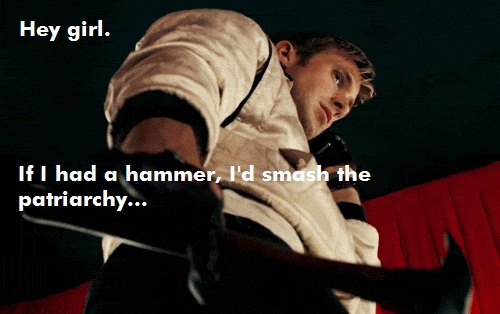
I watched Gangster Squad and Lars and the Real Girl in under 48 hours, so what? Ryan Gosling is a great actor... and I really like this meme. More relevant to this post, however, is his character in Lars and the Real Girl.

Lars was a loner and didn't know how to handle his emotions, so he directed all his affections toward a sex doll he named Bianca. While he may have intended to simply take refuge in this delusion, the whole town played along with it and cared for Bianca as if she were really his girlfriend. I won't ruin the ending for you, but the Tin Man gets his heart.

In other words, Switzerland, I love you, but your neutrality is a myth. Perpetual dispassion can resemble a wu wei demeanor but, at least personally, is probably more of a Wall. To be abidingly mild-mannered is not necessarily the same as to be apathetic. As with Jiro, simple daily and careful commitments (read: loving) can sum to excellence. 

But what exactly is the relationship between apathy, hate and love? Fear not, I have a diagram! Granted, it’s a graphic I grabbed from Google and edited in MSPAINT, but I think it works.


The central vortex is literally neutral territory, and thricely powerful centrifugal force makes it impossible to stay there.

So let's go clockwise as Klaus intended. Hate is blinding darkness (1 Peter, 1/2 Corinthians— somewhere in there) and cares so contrarily that it cannot know or refuses to see truth. I know from experience that hate can be a fun place to visit — Self: "Belle wouldn't like the Beast if he didn't transform into a handsome prince!" (Fun, if painful.) Sensible young lady: "Actually, she was hesitant to embrace him after his transformation." (So, I'm now so bitter I'm lying to support my hate.) — but it’s literally Hell to live in. Satan's curse is that he's trapped in hate, not apathy.

The end of apathy, however, is annihilation, which at least to Milton's demons in Paradise Lost is worse than Hell. It's difficult to imagine nothingness — Buddhists try their whole lives to — but I can't think of thoughtlessness slash apathy without recalling that scene from The Fountainhead. Doggedly critical journalist Ellsworth Toohey hounds Howard Roarke, the subject of his especial venom, "What do you think of me, Howard? What? Tell me!" Howard: "I don't."

Pretty certain that is crueler than hate. Howard doesn't even care or think about Ellsworth enough to hate him. And If I'm honest I see this in myself. (I try to hate it so that I might expel it from myself.) I don't often keep other people in mind and have hurt many by simply not thinking of them.

A certain incident with my roommate Paul comes to mind. I was writing and kept adding five more minutes until we would walk down to dinner together. His patience spent and his stomach screaming for even a Hot Pocket, he left without me. I, finally finished writing and finally feeling hungry, drove down past him to eat by myself then drove back up past him when I was done. That's cruelty by way of apathy. At that moment I literally had no thought or care for Paul re: his hunger. I assure you, this is something I rectified as the semester progressed.

Ambivalence and ignorance are both totally legitimate, but maintaining neutrality usually floats you out into the twelve o'clock of the circle of apathy. Admitting ignorance or apathy about a person or situation, however, is a fine start. In fact, it just might produce some feelings. Not necessarily loving feelings, but at least something to work with.

Bottom line: Caring is Quality. If you think you're largely apathetic, you're probably not letting yourself be drawn into one of the other two circles. And let's face it. It's risky to care.

January 17, 2013

Three Rs: Robotic Robots Review


The only music review I have ever written was for Pink Friday: Roman Reloaded, an album whose first four tracks I then looped for the next four months. This music review is for a very different album, one crafted by the enigmatic Ethan the Robot! during his 2008 summer in Heidelberg. But while it is nearly five years old it is, in many ways, still sealed in plastic. (Plus, I only got it in like September, so it's new to me.) If you want to listen to this album, you can download it off Dropbox here. What follows is my track-by-track analysis capped off with a summary, one I imagine quoted on the album's packaging.

1. My Electro Intro
The album starts with familiar enough Garage Band sound, but soon escalates into a full-fledged diddy— a microwave warm welcome to the album. It would be easy to write this track off as little more than an intro, but by its end it sounds more more like an Introitus to a Requiem than what it claims to be.

2. Mr. Cricket and the Wildflower
This song wins for best title and best story. Clearly a quirky, single man in his early forties has found himself in the first level of Sonic the Hedgehog and, rather than racing through the technicolor landscape, has decided to take a pleasant stroll to enjoy the scenery, even the wildflowers.

3. Blood Red Summer
The title invokes the blood red sun of the Japanese flag, but its sound is more of a lazy summer day on rural Honshu as in scenes of Ponyo rather than the seizure-inducing speed of Tokyo life. Picnicking atop a green suburban hill with a view of the Sea of Japan, the listener can almost taste the Sapporo shandy.

4. A Song I Made
An opaque title for a piece with a wide berth. Background chatter complements the plodding beat nicely as co-workers unwinding at the happy hour of a piano bar. This song is not boring, but is definitely ambient. The evening after a long summer day is preparation for a dark night ahead.

5. I Saw One Bird Eating Another Dead Bird
The cannibalism in this piece is largely psychological and ex post facto. You'll find no flesh rending in the bass clef piano licks, but guilt steadily growing louder. A sapphire light shines through in the end by way of treble piano play.

6. Underwater Radar Gun
While other pieces also spin-off Final Fantasy and Zelda soundtracks, this piece in particular feels like the inside of the Deku Tree in Ocarina of Time. But the Water Temple is also inside the tree, and all the overhead lighting has been updated with clean, white LED bulbs.

7. Morning Rainbow I: The Life of a Baby Dinosaur
You can hear the small triceratops trotting gleefully through the same landscape Mr. Cricket explored in track two. But to this little dino, the land is not to be admired for its detail but rather romped through as an open playground and breathed in rigorously, euphorically.

8. Morning Rainbow II: Rhythm and Instinct
This is mostly a straightforward rock song, even complete with guitar and drum solos. It gets back into the flow of the album near the end, squawking and beating home its electronic point.

9. Morning Rainbow III: The Attack of 2212
I don't know what the world will be like two hundred years from now, nor who would be attacking whom then. But this song foretells swift cavalry, in all their nobility and savagery, descending upon an isolated town. I'm unsure of the exact nature of the force — podracers on laser horses? — but the townsfolk are in deep doo-doo, especially because they can't decide whether to tarry to collect their valuables or to flee immediately. Either way, I don't think it ends well for them.

10. Morning Rainbow IV: Colored Rain
This title truly speaks for itself, and the song unfolds as a fine dessert to what has been a meal of fruit cocktails, raisins and marshmallow fluff.


This album is not only perfect to take a drug-induced mid-morning nap to, but is also a great soundtrack for several hours of data entry. It’s what they played when spring rolled round in irradiated Nagasaki, and it will one day blare proudly from the loudspeakers of Disneyland Mars.